The start of summer has been a productive and culturally enriching time for me. Armed with an English Heritage and National Trust membership, my partner and I have been exploring the local historical houses and castles. It’s still early into our adventures but I would like to give a small summary of some of the places we’ve visited so far. This article focuses on the properties owned by English Heritage, this will be followed next month by some of the properties belonging to the National Trust. The work they do is crucial to the conservation and restoration of sites that are important historically, architecturally and culturally.
Kirby Hall
The house was built by Sir Humphrey Stafford between 1570 and 1575 but was purchased by Sir Christopher Hatton (b.1540 – d.1591) after his death. The Hatton family started a process of modernisation in 1638 which included adding state rooms in order to accommodate royalty. Whilst Elizabeth I (b.1533 – d.1603) never visited, her successor James I of England and VI of Scotland (b.1566 – d.1625) did many times.
Upon entering the site, we are greeted by the north front of Kirby Hall, an impressive façade which leads into the courtyard. Tt’s design was heavily influenced by classical architecture. For example, the walls are embellished with pilasters of the Ionic order and a frieze carved with fruit. Furthermore, the pilasters on the north side of the courtyard have been carved with a design copied from ‘The first and chief grounds of architecture’ the first book printed in English to demonstrate the classical orders of architecture by John Shute in 1563.
The Hatton family also created the gardens, though they were redesigned with the help of nurseryman George London (b.1640 – d.1713) who visited in 1693. The garden was divided into four sections known as parterres which had elaborate patterns designed to impress visitors. These parterres also had statues of gods from classic mythology within them. The garden remains this way today.
Rushton Triangular Lodge
Hiding within the beautiful English countryside is a rather peculiar looking house. Built by Sir Thomas Tresham (b.1543 – d.1605) between 1593 – 1597 during the reign of Elizabeth I, Rushton Triangular Lodge was used as an assertion of his faith. Practising the Catholic faith at this time was dangerous with Sir Thomas himself being fined for not attending protestant church and then detained for this repeated offence. As shown by it’s name, the lodge was built with three sides and three floors inside to represent the Holy Trinity.
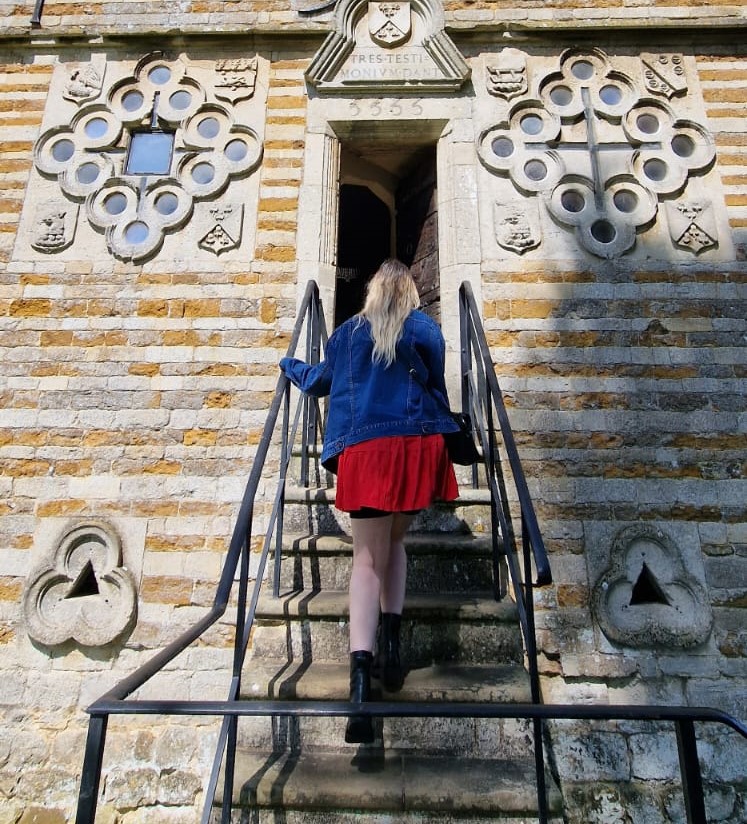
The windows are also shaped as trefoils, an important Christian symbol used in architecture. Many people who practiced Catholicism had their houses embellished with the trefoil in order to signal to other Catholics that they could seek refuge there. Whilst the lodge is small, it is also full of hidden symbols alluding to Thomas’s faith. In Elizabethan times they were called devices.
Lyddington Bede House
Lyddington Bede House has a varied history, starting in the 12th century as the wing of a palace belonging to the Bishops of Lincoln. However, after the reformation under Henry VIII (b.1491 – d.1547), it became the private house of the Cecil family. Thomas Cecil, 1st Earp of Exeter, converted it into an alms-house, which gave accommodation to twelve bedesman and two women over thirty years old. A bedesmen was a man of prayer who usually prayed for the soul of their benefactor in exchange for food and an allowance. The house was primarily used for this function until the early 20th century.

The tiny rooms which accommodated the bedesmen and woman are situated on the ground floor and can still be viewed as they were today, whilst the first floor shows what the house would have looked like in Medieval times. Visitors can also sneak up to the attic.
Kenilworth Castle
Founded in the 12th century around a Norman Great Tower, in the town of Kenilworth, the castle was developed by its various owners over hundreds of years. One owner of note was the famous Robert Dudley, 1st Earl of Leicester (1532 – 1588). Robert Dudley spent much of his time renovating the castle, adding the gardens, in order to impress Queen Elizabeth I. She visited four times, with her final visit in 1575 lasting for 19 days.
The ruins of Kenilworth are very impressive at first glance and give visitors the opportunity to explore the towers via several platforms which take its guests 18 meters up into the towers. Visitors can stand where Elizabeth I’s private rooms would have been whilst taking in breath taking views of the countryside. There are also opportunities to explore the castle keep which was originally built in the 12th century and the Great Hall, built in the 14th Century by John of Gaunt (b.1340 – d.1399)
The gardens have been recreated to resemble what they would have looked like during Queen Elizabeth I’s progress. In its centre is the marble Atlas fountain, carved with scenes from the Roman poet Ovid’s (b.43BC – d.17/18 AD) most well-known work ‘Metamorphoses’, surrounded by an array of flowers and herbs. It can be viewed, in all its splendour, from the terrace. For more on Kenilworth Castle, please visit my article on Mainly Museums
Conclusions
All these spaces have their own unique history ready to be explored. Each give use a fascinating look into the past and insight into the political, cultural and social landscape of the time. I look forward to exploring more English Heritage properties this summer. If you would like to join me on my adventure please take a look at my Instagram.
For more information on opening times, prices and accessibility please visit the English Heritage website.
Sources
Thurley,Simon. Kirby Hall. (English Heritage: London, 2020)
Girouard.Mark, Rushton Triangular Lodge (English Heritage: London, 2004)
English Heritage, English Heritage, <ttps://www.english-heritage.org.uk>
 The Museum Inspector
Leave a comment