As autumn draws in and the weather gets colder, I’ve been taking the time to reflect on a wonderful summer spent visiting historic houses and castles. Whilst my last article focused on English Heritage, this article will focus on the wonderful properties cared for by the National Trust.
Calke Abbey – Derby

Calke Abbey started off as a ‘cell’ of Repton Priory in the 12th century. However, during the Dissolution of the Monasteries, Repton Priory was dissolved with Calke Abbey being transferred back to the crown a few years later. John Preste, a Master Grocer of London, later acquired the property under a 99-year lease and converted it into a Tudor House. In 1622 the house ended up in the hands of the Harpur family. However it was Sir Henry Harpur Crewe, 7th Baronet (1763 – 1819) who renovated the Abbey. This included building a library and renovating the dining room which reflected the wealth of the family.

Following the death of Henry, the estate passed to his only surviving son George Crewe, 8th Baronet (1795 – 1844). Unlike his father, he was a community man and rebuilt churches and schools to help his tenants. However, he enjoyed collecting paintings and many of those that hang on the walls today are from his collection. The desire to collect things was carried on by George’s grandson Sir Vauncey Harpur-Crewe, 10th baronet, (1846 – 1924) taking an interest in natural history. As a result, Calke Abbey hosts the largest natural history collections owned by the National Trust.
Moving into the 20th century, the upkeep of the estate was too much and ended up in the care of the National Trust in 1985. The way in which Calke Abbey is presented is interesting and unusual. Rather than restore it to its glory days, the house is preserved the way it was found and gives us a glimpse into its last few years as a family home.
Belton House
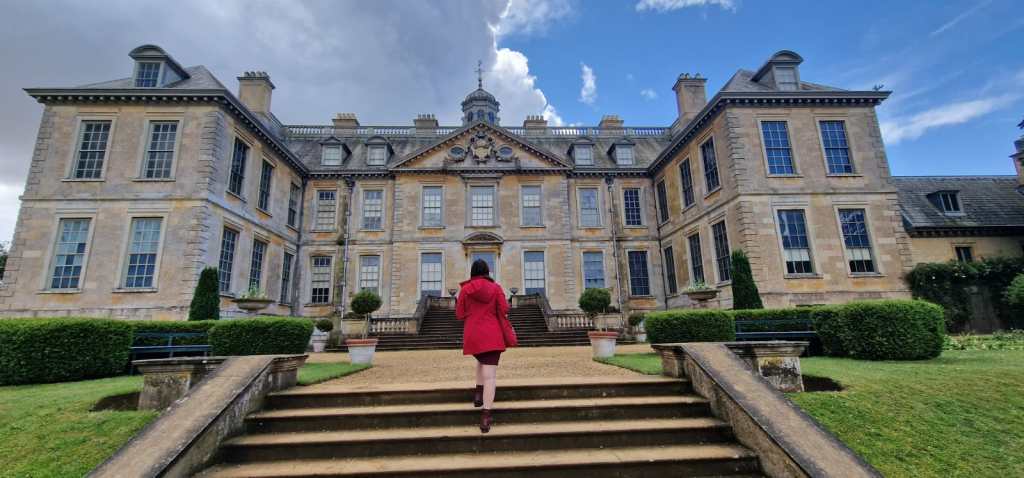


Some may recognise the grounds of Belton House, particularly the greenhouse, which was used for the filming of popular Netflix series Queen Charlotte.
The Grade I listed house was completed in 1687 for Sir John Brownlow (1659 – 1697), 3rd Baronet of Humby. Whilst the identity of the architect is unknown, evidence suggests that the house was designed by William Winde (c.1645 – 1722). The house is known for its Carolean architecture or restoration style architecture as it’s more commonly known. This style focuses on opulence which saw a return after the restoration of the monarchy in 1660. The interior of the house is equally as impressive and contains a range of family portraits, porcelain, silver, and a 17th century architectonic cabinet veneered in lapis lazuli. In 1690, an area of 1000 acres around the house was closed off and transformed into a park to keep deer. 21,440 ash trees and 9,500 oak trees were planted in the park. The house itself is surrounded by beautiful gardens and the famous greenhouse which can be viewed in the summer.
Kedleston Hall

Built between 1759 – 1765 by Nathaniel Curzon, 1st Baron Scarsdale (1726 – 1804) and following the designs of architect Robert Adam (1728 – 1992), the hall is an ode to classical architecture. Whilst the Curzon family had their own private living quarters within the house, certain rooms were built for the purpose of impressing visitors and were not actually lived in. One of these rooms is the Marble Hall.

Containing twenty Corinthian columns and casts of classical statues, it imitates the classical style of ancient civilisations. Additionally the Saloon, completed in 1963, is reminiscent of the Pantheon in Rome with its domed ceiling lit with a glass oculus in the centre. The walls are decorated with grisaille panels painted by John Biagio Rebecca (b?-d. 1847) which depict scenes of British worthies. Additionally as visitors journey around the rooms they will note Curzon’s love of symmetry which is particularly noticeable in the drawing room.
The hall also houses the Eastern Museum. Created in the 1920’s it displays one of the largest collections of Asian artifacts in the midlands. These objects came into the possession of the family in the late 19th century, due to Lord George Curzon’s (b.1859 – 1925) position as Viceroy of India. The collection mainly comes from Lord Curzon’s tours of Asia in 1887,1890 and 1894 but also holds a variety of artifacts of Islamic and Indo-Islamic origin. Current projects supported by the National Trust aim to broaden understandings of these objects through specialist research as well as examine and confront legacies of colonialism.
Conclusion
The work done by the National Trust to engage with the heritage and legacies of these buildings is magnificent and we look forward to visiting more of them in the future.
Sources
Calke Abbey’s history | Derbyshire | National Trust
Kedleston Hall’s history | Derbyshire | National Trust
 The Museum Inspector
Leave a comment