At the dawn of the new year, I got the chance to visit the ‘Latent Spaces’ exhibition by multidisciplinary artist Makos Kay. Accompanied by music composed by Jesse Solomon Clark and hosted by Illusionaries, an experimental art hub, this retrospective promises an immersive visual experience for its audiences. This new experience has been produced through Kay’s experimentation with generative art.
What is Generative Art?
When I was introduced to this exhibition, my first thought was what exactly is generative art? Tate defines it as art which is ‘made using a predetermined system that often includes an element of chance’.[1] Whilst this usually refers to computer-based art, my research showed that it has roots in 20th century modern art movements. Many of those movements such as Cubism, Surrealism and Abstract Expressionism incorporated autonomous processes into their work whilst others, such as futurism, had a pre-occupation with the growing influence of technology. This fascination with both autonomous processes and technology would culminate in the creation of generative art. As technology developed artists started to use algorithms to produce artwork, and now with artificial intelligence becoming more prevalent it isn’t surprising that AI-produced art has developed alongside it.
Controversies
Like the many art movements that have come before it, the way in which generative art is created has been a divisive topic. The main point of contention being that once a predetermined system has been put in place, there is usually little input from its originating artist. As a result, some have disputed whether the products of these systems can be labelled as art since the artist has seemingly relinquished control of the end result to a machine. But, whilst controversial, it is important to note that the successful use of algorithms and various programmes to create this art is due to years of experimentation. For example, Kay’s retrospective is the result of two decades of refinement. With that in mind, I think it’s only fair to explore this type of art as it becomes more prominent in our society.
The Exhibition
The exhibition consists of four rooms designed to engage the senses, presenting a variety of animated images, set against music composed by Jesse Solomon Clark, for its audiences to ponder. These rooms are accessed through a corridor of hanging, beaded lights which set the tone for what is to follow.
The first room ‘Formation Space’ finds it’s audiences confronted by images of vaguely recognisable creatures bursting with intense colour.
The Second room ‘Complexity Space’ makes use of mirrors to surround the viewer with alien landscapes.
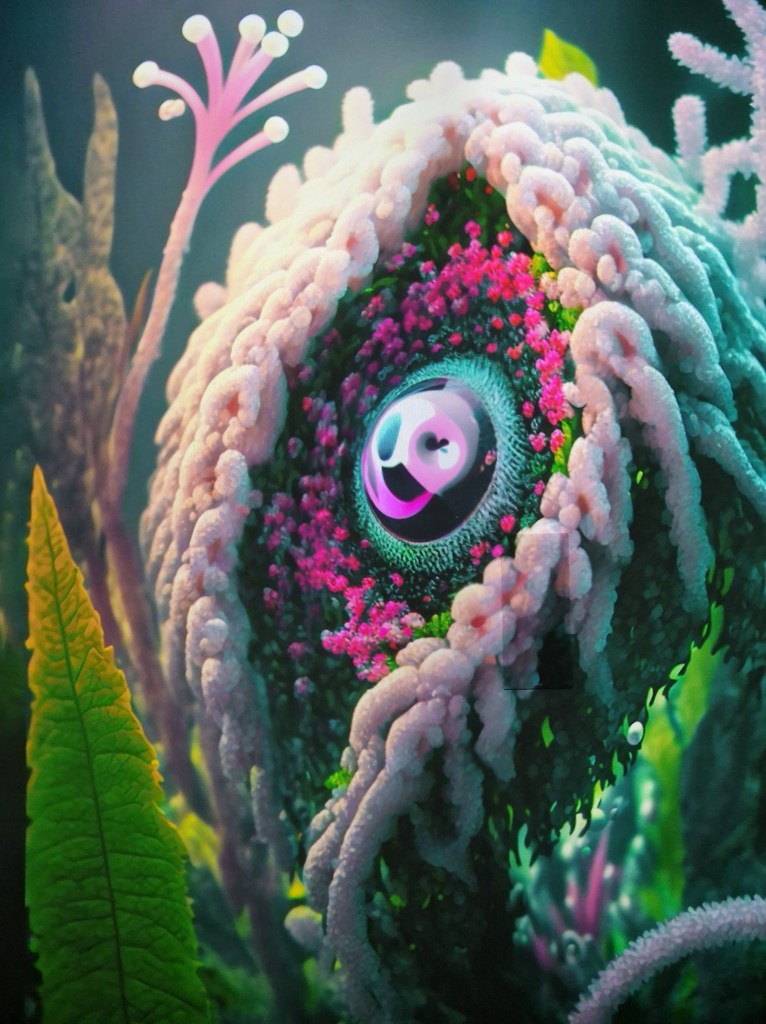

‘Breathing spaces’, my favourite room, invites visitors to sit on one of the large cushions placed around the room and draws our focus to a series of outlandish animals.
The last room, ‘Agents Space’ finds you staring into the unflinching eyes of inhabitants from futuristic civilizations.

Conclusions
I found this to be a calming almost mediative experience. The images that Kay has created through a mix of creativity and technological innovation, are hypnotic and memorable. He provides an experience that can be enjoyed and contemplated at the viewers own pace.
Information
Location: Illusionaries, Crossrail Place, Canary Wharf, London, E14 5AR
Price: Adults from £24, Discounted for Students and over 65’s. Children under 3 go free.
Website: ‘Latent Spaces’ | Illusionaries
Sources
Generative Art: Origins, Artists, and Exemplary Works (2019) <https://www.invaluable.com/blog/generative-art/> [accessed 22 January 2024].
Generative Art (2023) <https://www.tate.org.uk/art/art-terms/g/generative-art> [accessed 24 January 2024].
Illusionaries (2023) <https://www.illusionaries.com/latentspaces> [accessed 24 January 2024].
[1] Generative Art (2023) <https://www.tate.org.uk/art/art-terms/g/generative-art> [accessed 24 January 2024].
 The Museum Inspector
Leave a comment