Our latest international adventure took place in Vienna, Austria. Known for its rich history, particularly being the seat of the Hapsburg Empire from 1282 until 1918, visiting this wonderful was an opportunity not to be missed. Armed with the Vienna Pass which gives it’s owner access to many of Vienna’s top cultural sites and attractions, we explored the beautiful baroque city. We crammed a lot of museums (and I mean a lot!) into our itinerary and it was hard for me to create this list of recommendations. The five museums that I have listed had exhibitions that intrigued me either through a particular subject or through the techniques they used to exhibit information about the history of Austria.
The Sisi Museum
As the name suggests, this museum is dedicated to understanding the life of Empress Elisabeth of Austria (b.1837 – d.1898) or ‘Sisi’ for short who was married to Franz Josef I of Austria (b.1830 – d.1916) at the age of 16. Whilst having a happy childhood she was reluctant to take on the pressures of court life which came with being Empress of Austria as she found them constraining. Prone to bouts of melancholy she would travel incognito around Europe. She has been both romanticised and misunderstood throughout history, her life blighted by many moments of personal tragedy which culminated in her own assassination at the hands of Italian Anarchist Luigi Lucheni (b.1873 – d.1910).
The exhibition tells her story through a number of personal items including her letters, clothes and traveling case. We get a very deep sense of her complex personality as well as her views on court life. We see the tender human that she was, not just the monarch. Audiences will also get the chance to walk in her shoes and explore her preserved personal apartments.
In all honesty, before visiting this museum, I only had a vague idea of who Sisi was. This museum tells the story of her life beautifully and gave me a better understanding of her. This museum both intrigued and delighted me and is not to be missed.
For more information visit their website.
Austrian National Library
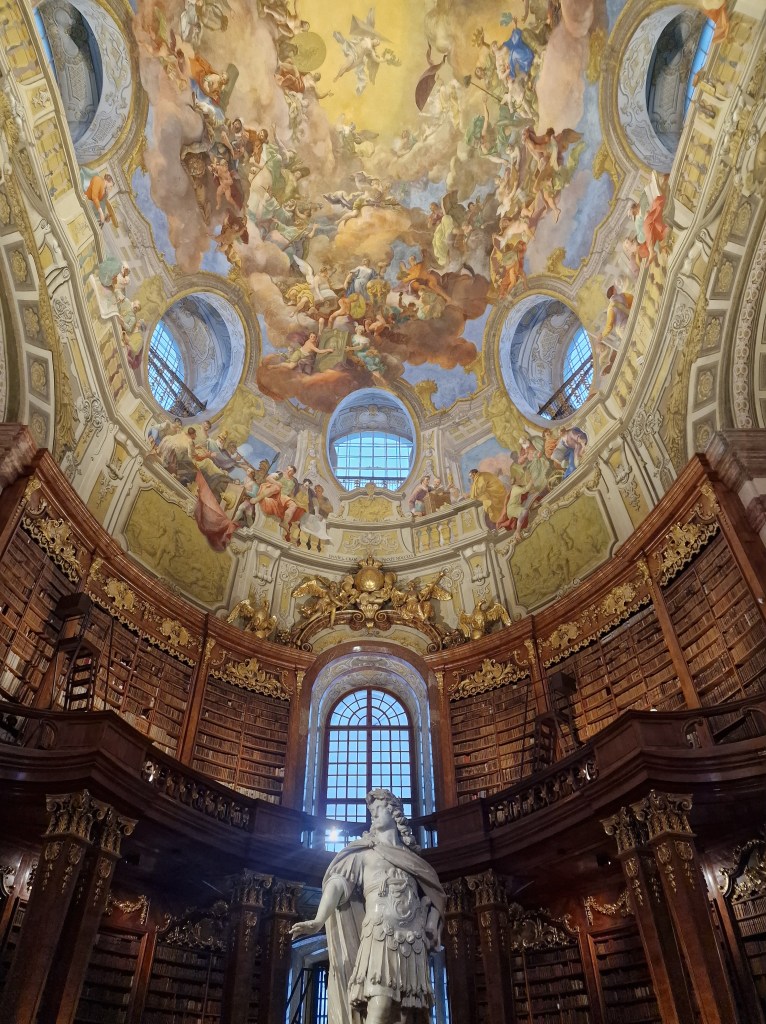
This Library is a must for bibliophiles and is the largest library in Austria! Whilst it is a functioning library with reading rooms and places for students to study, the State Hall can be visited by the public.
Located in the Hofburg, formally the Imperial Palace of Austria’s ruling family the Hapsburgs, the State Hall was initially built for their private use.
Commissioned by Emperor Charles VI (b.1685-d.1740) in the 18th century and decorated in the baroque style, the State Hall boasts beautiful frescoes and ornately carved dark walnut shelves. A statue of Charles VI stands in the centre of the library surrounded by four large Venetian globes. It holds over 200,000 books dating from between 1501 to 1850 which were collected from the various reaches of their empire.
This library is an incredible feat of interior design and also holds a wealth of knowledge for those to understand the history of the Hapsburg Empire.
Find out more about visiting the library, here.
Albertina Art Museum
The Albertina Museum was a personal favourite of mine due to my love of impressionism and expressionism. Whilst I know that this won’t be everyone’s cup of tea, this is a must see for those with a love of 19th and 20th century art movements. From Claude Monet to Paul Signac and Franz Marc, the galleries permanent collection shows an array of works which challenged conventional notions of painting at the time. These painters brought bold new styles to the world of art and revolutionised the way in which we think about art in our own social and cultural landscapes.
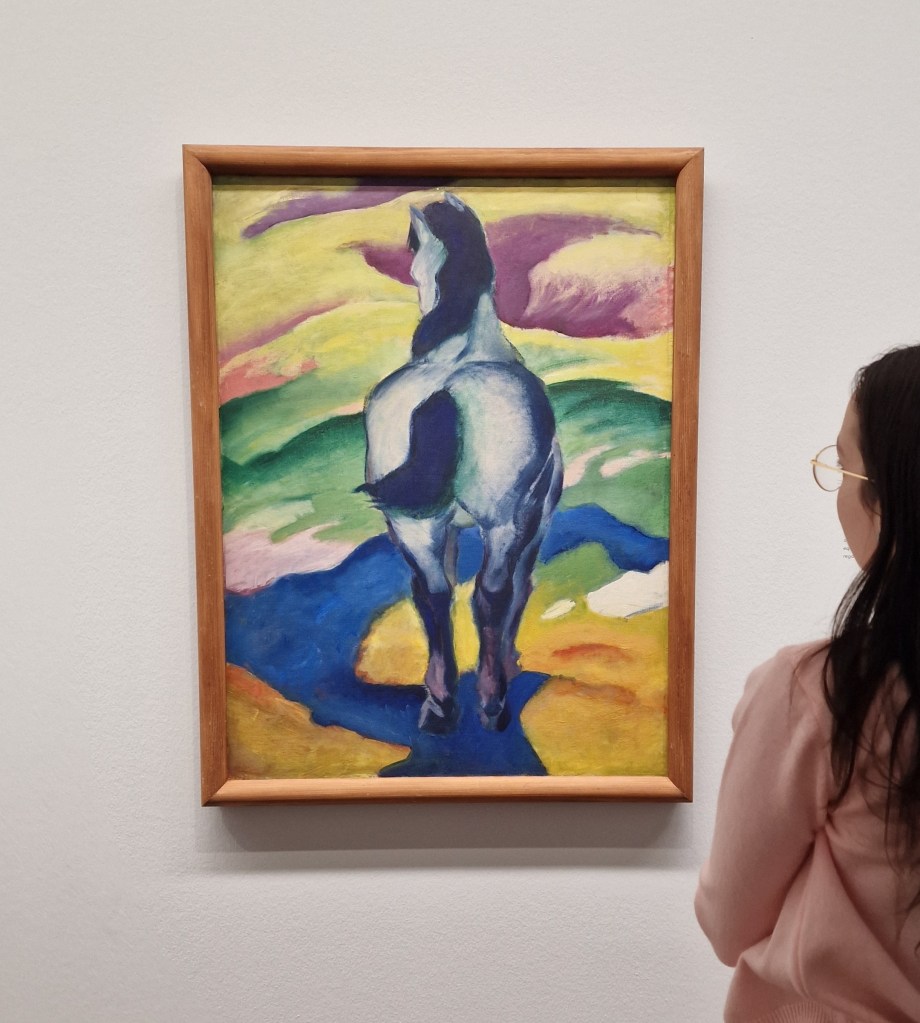
The Albertina also hosts excellent temporary exhibitions. During our visit, the ground floor exhibited: ‘Matthew Wong – Vincent Van Gogh: Painting as a Last Resort’ which examines Wong’s work and how he was influenced by Van Gogh.
However, the Albertina also houses the largest print rooms in the world, holding 65,000 drawings and 1 million old master prints along with photographs and architectural drawings making it a valuable resource in the study of art and history.
Find out more about this museum.
House of Austrian History
Also located in the Hofburg, this small museum focuses on Austria’s social history from 1918 onwards. It takes it’s audience on a journey through the social and political unrest of the early 20th century which saw the end of the Hapsburg empire and the start of Austria as a republic. It also confronts issues arising from Austria’s occupation by the Nazi Party in the second World War. The interactive exhibits also take us into present day Austria, telling it’s history through the eyes of ordinary people.
Whilst this museum was small, many of their exhibitions allowed me to interact with them and take part in about freedom of speech and give my opinions on important historical events. I think that this kind of engagement within museum spaces is key to encouraging audiences to become involved in historical discourse and I look forward to see how the museum’s exhibitions evolve in the future.
Visit their website.
Lower Belvedere
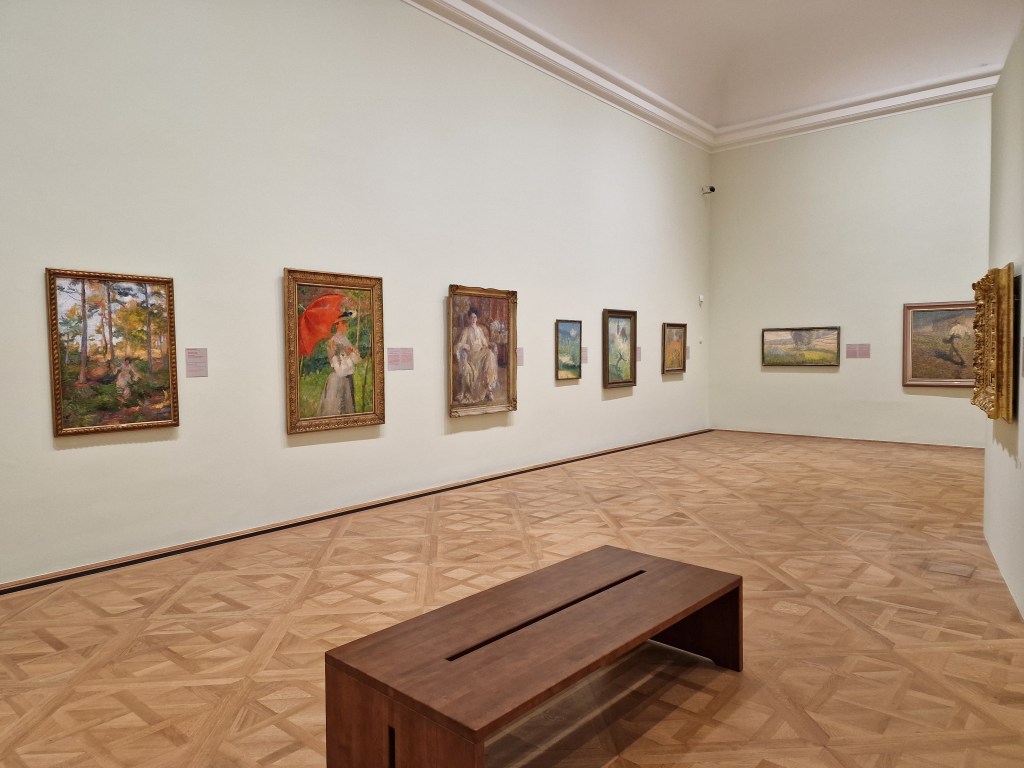
The former residential palace of Prince Eugene of Savoy (b.1663 – d.1736), the Lower Belvedere hosts an exquisite array of temporary exhibitions.
The largest space is dedicated to ‘The World in Colours: Slovenian Painting 1848 – 1918’. This is a retrospective which which puts a spotlight on the defining characteristics and techniques of Slovenian painting. This exhibition enriched my understanding of some of my favourite modern art movements in relation to how Slovenian Impressionists influenced international artists such as Wassily Kandinsky (b.1866-d.1944) who trained under featured artist Anton Ažbe (b.1862–d.1905) between 1897 and 1899. These were formative years for Kandinsky who would go on to influence the worlds of German Expressionism and Abstractionism. Furthermore, through the works presented in this exhibition, audiences gain a better understanding of Slovenian artists’ relationship with Austria.
Towards the rear of the Lower Belvedere was ‘Gustav Klimt – Pigment and Pixel: Rediscovering Art Through Technology’. This exhibition uses radiology to analyse the paintings of Gustav Klimt (b.1862-d.1918) and look at the techniques used by the artist, particularly in his ‘gold period’. They have also researched Klimt’s University of Vienna Ceiling Paintings which were destroyed by a fire in 1945. Only black and white images remained. However technological techniques, including the use of AI, were used to reconstruct the original colours of the paintings and create copies which can be viewed in this exhibition.
Find out more about their exhibitions, here.
Conclusions
We had a truly magical time in Vienna. For anyone planning a journey these museums are a must. However, I recommend the purchasing of the Vienna Pass which includes all of these and much more. The entrance fee to many museums in Vienna are a bit pricey and the pass will save you money as well as give you fast track entry. There are options for 1,2,3 and 6 day passes depending on the duration of your stay. I would also recommend getting a transport pass for access to the trams and underground. It cost 20 euros for six days and was a life saver for my feet!
 The Museum Inspector
Leave a comment